
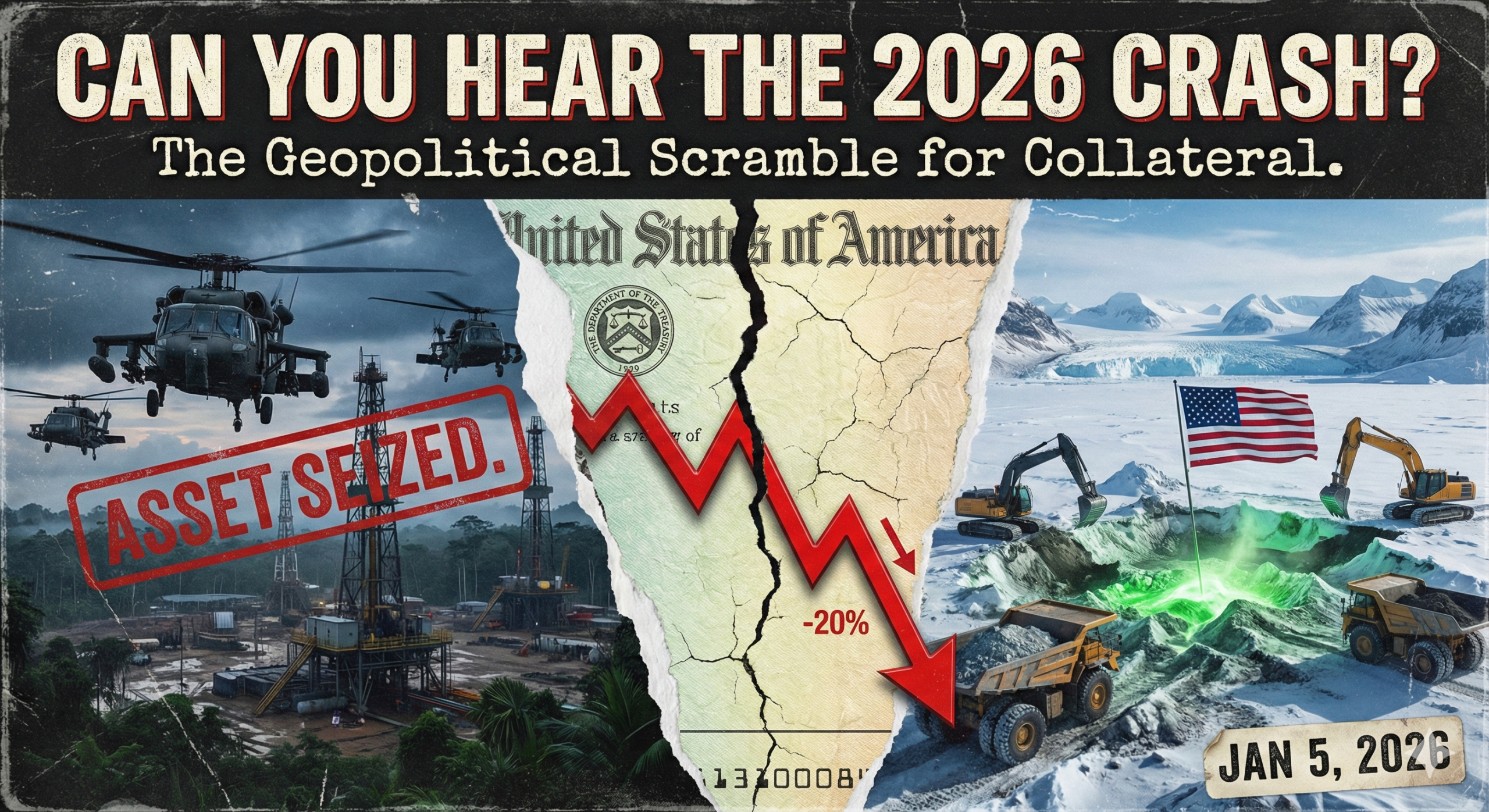
If you look at the debt clock today, you will see a number that defies human comprehension: $38 Trillion.
For decades, we were told this number was a harmless scorecard. We were told that deficits don’t matter because “we owe it to ourselves.” But as of 2024, the mathematical reality of the United States shifted. For the first time in the history of the republic, the U.S. government spent more on interest payments to service its debt than it did on national defense.[1]
We have officially entered a debt spiral. The government is now prioritizing bondholders of the past over the security of the present. But the true danger isn’t that the U.S. will default on this debt. The danger is that they won’t.
Instead, Washington has quietly initiated a “Soft Default”—a strategy of Financial Repression designed to liquidate the middle class to save the state. This policy is the invisible force that will drive the Stock Market Crash of 2026 and force a historic exodus of capital into overseas assets.
The Mechanism of the “Soft Default”
The government cannot pay off $38 trillion in honest money. To do so would require austerity measures—doubling income taxes or abolishing the military—that would be political suicide.[1]
Instead, the Treasury and the Federal Reserve have fused into a single entity to execute a “Soft Default.” The plan is simple but devastating: keep interest rates lower than the rate of inflation.
If inflation is running at 5% but the Treasury pays bondholders only 4%, the government is effectively erasing 1% of its debt burden every year in real terms. They are paying back their obligations with devalued currency. This is not an accident; it is a calculated liquidation of your purchasing power.[1]
But this strategy has a fatal side effect: it destroys the incentive to save or invest in U.S. assets.
The Illusion of the “Everything Bubble”
Until recently, this money printing (the “Cantillon Effect”) fueled the stock market. Freshly printed dollars flowed into Wall Street first, inflating asset prices before trickling down to wages. This created a “monetary mirage” where the S&P 500 looked like it was gaining value, when it was simply being repriced in weaker dollars.[1]
However, by 2026, the math changes. The sheer volume of debt issuance required to pay interest on the old debt creates a liquidity crisis. The government is now issuing new credit cards just to pay the minimum balance on the old ones.[1]
This leads to Fiscal Dominance: the Federal Reserve loses its independence and is forced to print money primarily to keep the Treasury solvent, regardless of inflation.
The Crash of 2026: The “Captive Buyer” Revolt
So, why does the market crash in 2026? Because the “greater fool” theory runs out of fools.
The government has built a trap known as the “Captive Buyer.” Through regulations like Basel III and Dodd-Frank, banks and pension funds are legally required to hold U.S. Treasuries as “High-Quality Liquid Assets” (HQLA). They are forced to buy the government’s debt even as it loses value.[1]
But individual investors, family offices, and foreign sovereign wealth funds are not captive.
By 2026, the realization hits: The U.S. stock market is no longer a generator of wealth, but a mechanism for wealth transfer. Investors realize that holding U.S. assets subjects them to the “inflation tax.” When the real rate of return (Nominal Return minus Inflation) turns permanently negative, the smart money doesn’t just sell; it leaves the jurisdiction entirely.
The Great Capital Flight: Why Money is Moving Overseas
The crash of 2026 won’t necessarily look like 1929. It may look like a “melt-down” in real value. As the U.S. tries to inflate away its $38 trillion debt, investors will pull their capital from American equities and move it to three specific overseas havens:
- Commodity-Backed Economies: Capital will flee to nations that produce hard assets—oil, gold, copper, and agriculture—rather than financial derivatives. These economies benefit from the very inflation that hurts the U.S. consumer.
- Emerging Markets with Positive Real Yields: Unlike the U.S., many developing nations cannot print their way out of debt. They are forced to offer positive real interest rates to attract capital. Investors will swap overvalued U.S. tech stocks for bonds in countries where they actually get paid to lend money.
- Non-Dollar Jurisdictions: As the U.S. weaponizes the dollar and dilutes its value, the “risk-free” status of American assets evaporates. Wealth will migrate to jurisdictions that are not reliant on the SWIFT system or the Federal Reserve’s monetary policy.[1]
The End of the “Risk-Free” Era
The strategy of “Soft Default” works only as long as people believe the lie that 4% interest in a 5% inflation world is a good deal. That illusion is shattering.
The crash of 2026 will mark the end of the 40-year era where you could blindly dump money into a U.S. index fund and expect to retire wealthy. The government is erasing its $38 trillion debt by erasing the value of the currency that debt is denominated in.
For the investor, the only move left is to step out of the blast radius. The era of the U.S. stock market as the world’s default piggy bank is over; the era of global asset survival has begun.
Sources
[1] How the U.S. is Quietly Erasing $38 Trillion in Debt (And Your Savings) https://www.youtube.com/watch?v=LSZZJ_AmcCE
