
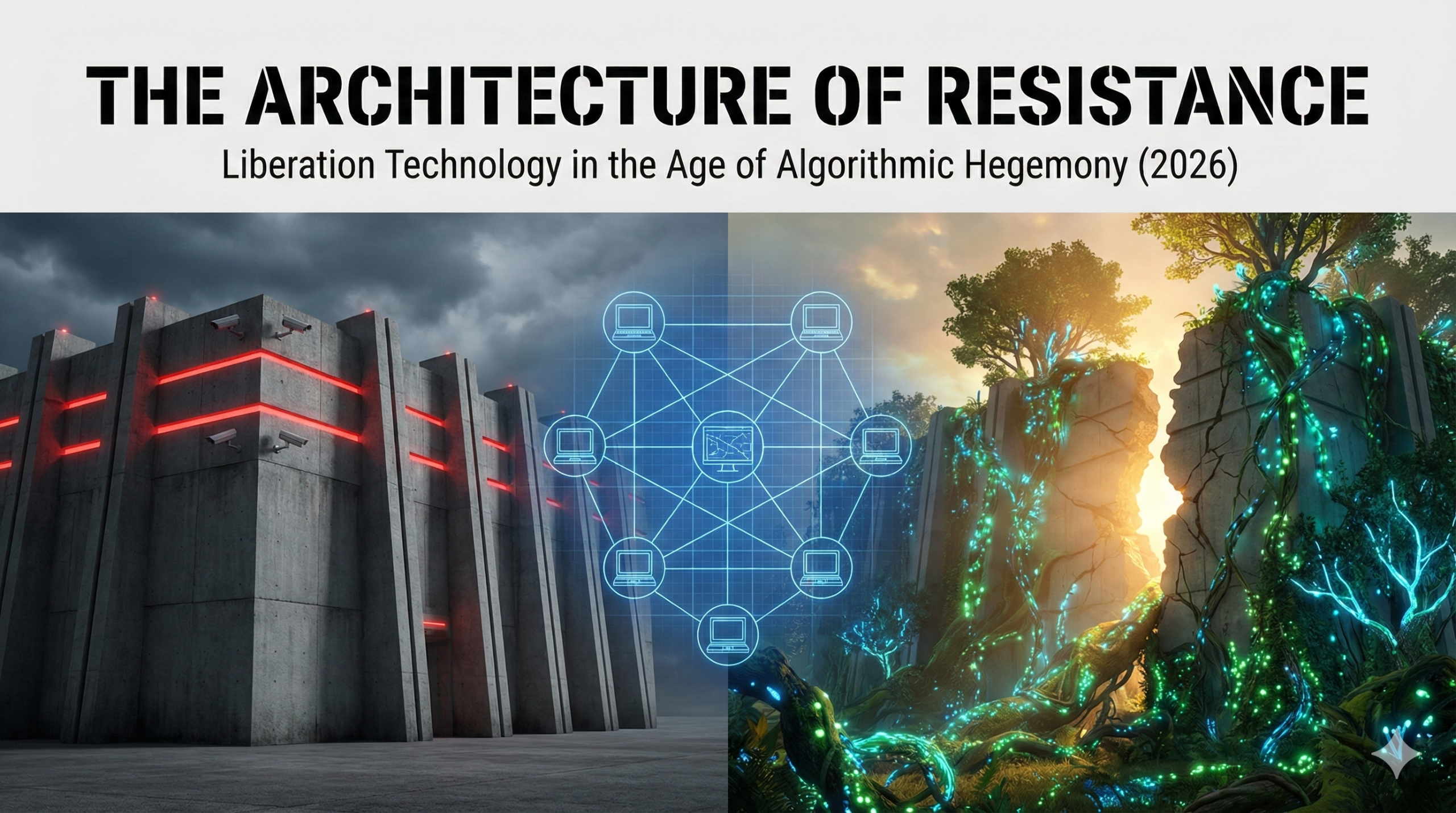
1. Introduction: The Metamorphosis of Liberation Technology
As the world crosses the threshold into 2026, the domain of “Liberation Technology” has undergone a fundamental and irreversible metamorphosis. The term, once imbued with the techno-optimism of the early 2010s—where social media platforms were viewed as inherent catalysts for democratic mobilization—has matured into a discipline defined by asymmetric digital warfare, cryptographic sovereignty, and infrastructure resilience. The liberation technologist of 2026 is no longer merely a digital activist maximizing engagement on corporate platforms; they are an architect of parallel networks, a forensic analyst of mercenary spyware, and a navigator of the “digital double bind”.1
This report provides an exhaustive analysis of the state of liberation technology in 2026. It synthesizes data from global internet freedom indices, technical papers on censorship circumvention, forensic reports on transnational repression, and the strategic roadmaps of decentralized protocol developers. The analysis reveals a landscape where the battle for human rights has migrated from the application layer to the protocol and physical layers of the internet stack.
1.1 The Strategic Context: Fifteen Years of Decline
The operational environment is shaped by a grim historical trajectory: global internet freedom has declined for 15 consecutive years.2 The 2025 Freedom on the Net report paints a picture of a digital sphere that is more controlled, manipulated, and surveilled than at any point in history. The deterioration is not limited to authoritarian regimes; it encompasses democratic backsliding in nations like Georgia and the United States, where restrictions on civic space and the detention of foreign nationals for online expression have contributed to a lowering of freedom scores.2
In this context, the liberation technologist faces an adversary that has industrialized repression. The “kill switch”—the total shutdown of internet connectivity—has become a standard weapon of war and crowd control, deployed with devastating effect in conflicts ranging from Myanmar to Sudan and Gaza.5 Simultaneously, the rise of “digital sovereignty” laws has Balkanized the open web, replacing the global internet with a patchwork of national intranets patrolled by AI-driven gateways.
1.2 The Concept of the “Digital Double Bind”
A critical theoretical framework for understanding the 2026 landscape is the “digital double bind.” As articulated in research focusing on the Middle East and the Global South, this concept describes the paradoxical reality where digital transformation is simultaneously a vehicle for economic modernization and a mechanism for granular state control.1 Governments invest heavily in ICT infrastructure (5G, data centers) to drive economic diversification and efficiency. However, this same infrastructure forms the backbone of a surveillance state that tracks movement, financial transactions, and social interactions.
For the activist, the double bind means that engaging with the digital economy—necessary for survival—exposes them to the state’s coercive apparatus. The task of the liberation technologist, therefore, is to break this bind: to build tools that allow for economic and social participation without surrendering to the panopticon.
2. Digital Authoritarianism 2.0: The AI-Driven Panopticon
By 2026, the adversary has evolved. Authoritarian regimes have integrated Artificial Intelligence (AI) into the core of their information control strategies, moving from reactive censorship to predictive suppression.
2.1 The “Party’s AI”: Multimodal Censorship in China
The People’s Republic of China (PRC) remains the primary laboratory for digital repression technologies. The Australian Strategic Policy Institute (ASPI) released a landmark report in late 2025 titled “The Party’s AI,” which documents how the Chinese Communist Party (CCP) has deployed Large Language Models (LLMs) and computer vision systems to reshape human rights.6
2.1.1 From Keywords to Semantics
Traditional censorship relied on blacklists of keywords or hash-matching of known illicit images. This system was brittle; activists could bypass it using homophones, “Algospeak,” or slightly altered images. The new generation of AI censors employs semantic analysis. These systems do not just scan for words; they interpret the meaning and intent of a post.
- Contextual Awareness: An AI model can now flag a post that contains no banned words but conveys a banned sentiment—for example, a vague poem referencing “darkness” on the anniversary of the Tiananmen Square protests.6
- Multimodal Integration: The new censorship apparatus processes text and images simultaneously. It can detect a political slogan written on a T-shirt in a video, or understand a meme that combines a benign image with a sarcastic caption. This closes the “memetic gap” that activists previously exploited.
2.1.2 Predictive Policing and Pre-Crime
The integration of AI extends beyond censorship to predictive policing. By aggregating data from surveillance cameras (facial recognition), social media activity, and consumption patterns, the CCP’s systems generate risk scores for individuals. This allows the state to preemptively detain or restrict individuals who fit the profile of a potential protestor, even before they have committed any infraction. This industrialization of control creates a “chilling effect” where the boundaries of permissible speech are invisible and constantly shifting, enforced by an algorithmic black box.6
2.2 The Great Firewall: The War on Transport Protocols
The technical battle for connectivity has escalated to the transport layer. In 2025, researchers confirmed a significant upgrade to the Great Firewall (GFW): the ability to block QUIC (Quick UDP Internet Connections) traffic based on the SNI (Server Name Indication) field.7
2.2.1 The Mechanics of SNI Blocking
The SNI is a field in the TLS handshake that indicates which website the client wants to reach. While the content of the connection is encrypted, the SNI has historically been sent in plaintext (to allow the server to present the correct certificate). The GFW utilizes this leak to block access to specific sites hosted on shared infrastructure (like Cloudflare or Google Cloud) without blocking the entire IP address.
Research presented at USENIX Security 2025 revealed that the GFW’s blocking of QUIC is bidirectional and stateless, yet highly sophisticated. The GFW uses a “fingerprinting” algorithm to distinguish QUIC packets from other UDP traffic.7
- Vulnerability: This allows the censor to pinpoint and drop connections to forbidden sites even when they are using modern, encrypted transport protocols.
- Countermeasures: The liberation tech community has responded with Encrypted Client Hello (ECH). ECH encrypts the SNI field, hiding the destination from the censor. However, the adoption of ECH forces a high-stakes dilemma: the censor must either allow the traffic (losing visibility) or block all ECH traffic (potentially disrupting vast swathes of legitimate commercial activity).
2.2.2 Advanced Obfuscation: Reality and V2Ray
To counter Deep Packet Inspection (DPI), developers have created protocols that mimic “normal” traffic so perfectly that censors cannot distinguish a VPN connection from a regular website visit.
- Reality Protocol: Part of the XRay/V2Ray suite, this technology allows a user to “steal” the TLS certificate of a legitimate, high-reputation foreign website (like a university or a cloud provider) for the handshake.8 To the censor’s DPI middlebox, the traffic appears to be a valid connection to that innocuous site. It eliminates the need for the user to purchase a domain name, which creates a paper trail and is liable to be blocked.
- Traffic Shaping: Because censors now analyze the timing and size of packets (side-channel analysis) to identify VPN tunnels, new tools introduce “chaff” (fake packets) and random delays to alter the traffic fingerprint, making it statistically indistinguishable from random web browsing.9
2.3 Generative AI as a Weapon of Influence
Beyond blocking content, authoritarian regimes use AI to flood the information space. OpenAI’s October 2025 threat intelligence report details how threat actors from Russia and China use generative AI to streamline “influence operations” (IO).10
- Content Generation: Actors use LLMs to generate thousands of unique social media posts, comments, and articles that push a specific narrative (e.g., criticizing Ukraine or promoting the CCP). This removes the language barrier and the resource constraints of human “troll farms.”
- The “Gray Zone”: These operations operate in the gray zone, using AI to rewrite content so that it bypasses platform spam filters while maintaining the propaganda message. The goal is not just to persuade, but to exhaust the audience with noise, creating a sense of apathy and confusion.10
3. The Protocol Revolution: Decentralization as Defense
The centralization of the social web (Web 2.0) has proven to be a catastrophic vulnerability for human rights. Platforms like X (formerly Twitter), Facebook, and YouTube act as single points of failure, vulnerable to billionaire acquisition, state coercion, and algorithmic manipulation. In 2026, the liberation technology movement has decisively shifted toward decentralized protocols.
3.1 The AT Protocol and Bluesky: Federated Resilience
By late 2025, Bluesky had established itself as a major force with over 38 million users, but its significance lies in its architecture: the AT Protocol.11
3.1.1 Governance and Standardization
In a move to secure the long-term viability of the network, Bluesky submitted the AT Protocol to the Internet Engineering Task Force (IETF) for standardization in late 2025.12 This action is critical for liberation technologists; it transforms the protocol from a corporate product into a public utility, similar to HTTP or SMTP. It ensures that the underlying mechanics of the network cannot be easily altered or enclosed by a future owner.
3.1.2 Algorithmic Choice
The AT Protocol introduces the concept of “Algorithmic Choice” or “Algorithmic Pluralism.” Unlike monolithic platforms where a single, opaque algorithm determines what all users see, the AT Protocol allows users to subscribe to different “feed generators”.11
- Activist Utility: This feature allows communities to build “trusted feeds.” For example, a “Human Rights Feed” could prioritize content from verified NGOs and journalists while filtering out state-sponsored bots and hate speech. This effectively decentralizes content moderation, placing control in the hands of the user rather than a central trust and safety team.
3.2 Nostr: Cryptographic Sovereignty
While Bluesky offers a bridge to the mainstream, Nostr (Notes and Other Stuff Transmitted by Relays) represents the radical edge of censorship resistance. Nostr is not a platform but a protocol for publishing signed notes.13
3.2.1 The Relay Architecture
Nostr eliminates the concept of a central server entirely.
- Mechanism: A user signs a message with their private key and broadcasts it to multiple independent “relays.” Clients (apps) connect to these relays to retrieve messages.
- Resilience: If a relay operator decides to ban a user or is forced to shut down by a government, the user’s identity (their public key) and their content remain accessible on other relays. “Deplatforming” is mathematically impossible; censorship requires the simultaneous shutdown of every relay on earth.14
3.2.2 The Integration of Value: Bitcoin and Assets
Nostr has deeply integrated with the Bitcoin Lightning Network through a mechanism known as “Zaps.” This allows for instant, micropayment-based tipping and funding.
- Economic Resistance: In 2025, the “Nostr Assets” protocol began enabling the transfer of stablecoins and other assets over the network.14 For activists in countries with hyperinflation or financial sanctions (e.g., Turkey, Venezuela, Russia), this provides a parallel financial system that is as censorship-resistant as their communication channel. The ability to receive funding directly from supporters without a bank intermediary is a game-changer for the sustainability of dissent.
4. The Physical Layer: Mesh Networks and Sovereign Hardware
When the state deploys the “kill switch”—severing all connections to the global internet—software solutions become irrelevant. In 2026, the vanguard of liberation technology has moved to the Physical Layer, building independent infrastructure that operates off the grid.
4.1 Meshtastic: The Infrastructure of Last Resort
Meshtastic has emerged as the definitive tool for off-grid communication in 2025/2026. It utilizes LoRa (Long Range) radio technology to create a decentralized mesh network.15
4.1.1 Technical Capabilities
- Hardware: The devices are inexpensive (under $50), low-power microcontrollers equipped with LoRa radios. They can run for days on small batteries or indefinitely with small solar panels.15
- Range: LoRa allows for communication over several kilometers (or further with line-of-sight).
- Mesh Topology: Every device acts as a relay. A message sent from Device A can “hop” through Devices B, C, and D to reach Device E, extending the network’s range across an entire city or region without any central infrastructure.
4.1.2 Activist Use Cases
- Protest Coordination: In scenarios of heavy police surveillance or cellular blackouts, activists use Meshtastic for encrypted group communication. Because the devices do not emit cellular signatures (IMSI) and use ephemeral encryption keys, they are significantly harder to track than mobile phones. They allow organizers to broadcast warnings or coordinate movements without relying on the compromised cellular grid.16
- The “Digital Go-Bag”: By late 2025, security trainers for human rights defenders began recommending the inclusion of a Meshtastic node in “digital go-bags,” alongside secondary phones running privacy-focused operating systems like GrapheneOS.17
- Disaster Response: Meshtastic networks have been deployed to support indigenous communities in the Arctic and in disaster zones where traditional infrastructure has failed, providing a blueprint for community-owned resilience.18
4.2 Sovereign Hardware: The Quest for Trust
Software security relies on the integrity of the hardware it runs on. In an era of supply chain interdictions and hardware backdoors, liberation technologists are increasingly turning to Sovereign Hardware.
4.2.1 Precursor and Betrusted
The Precursor device, developed by the Betrusted project (led by Andrew “bunnie” Huang), represents the pinnacle of this philosophy.
- FPGA Architecture: Unlike standard smartphones that use proprietary, black-box CPUs (from Qualcomm or Apple), Precursor uses a Field Programmable Gate Array (FPGA). The CPU itself is “soft”—it is code loaded onto the FPGA. This allows the user to inspect and verify the design of the processor itself.19
- Root of Trust: This architecture allows the user to establish a “root of trust” that they control. It is designed for high-risk users (journalists, diplomats) who need to manage encryption keys or communicate securely without fear of deep-layer hardware exploits.20
5. Digital Transnational Repression: The Borderless Threat
A defining feature of the 2026 landscape is the globalization of repression. Authoritarian regimes are no longer content to silence dissent within their own borders; they utilize technology to reach into democracies to harass, surveil, and silence exiles and diasporas. This phenomenon is known as Digital Transnational Repression (DTR).
5.1 The Mercenary Spyware Ecosystem
The market for commercial spyware has expanded despite attempts at regulation. While NSO Group (makers of Pegasus) remains infamous, new players have emerged.
- Paragon Solutions: In 2025, Citizen Lab identified Paragon Solutions and their “Graphite” spyware as a major threat. Unlike NSO, which often courts publicity, Paragon operates in the shadows. Citizen Lab’s forensic analysis confirmed that Graphite was used to target journalists in Europe, including Italian reporter Ciro Pellegrino.21
- Zero-Click Exploits: Graphite utilizes advanced zero-click exploits (such as CVE-2025-43200 in iOS) to infect devices without any user interaction. Once compromised, the spyware provides total access to the device’s data, microphone, and camera.21
5.1.1 Infrastructure Analysis
Citizen Lab’s investigation into Paragon revealed a sophisticated, multi-tiered infrastructure designed to evade attribution.22
- Tier 1 Nodes: Cloud-based servers used for command and control.
- Tier 2 Nodes: Servers hosted on local ISPs, likely on the premises of the government customers. This “hybrid” model complicates attribution, as traffic appears to terminate at generic cloud providers or local ISPs rather than known intelligence agencies.
5.2 The Geopolitical Response
The severity of DTR has forced a geopolitical response.
- G7 Action: At the 2025 G7 Summit in Kananaskis, Canada, leaders issued a statement formally recognizing DTR as a threat to national sovereignty and human rights.23
- The Detection Academy: The G7 launched a “Digital Transnational Repression Detection Academy” to train civil society and law enforcement in the identification of these threats.25 This represents a crucial shift: the burden of defense is moving from the individual activist to a collective, state-supported defense posture.
6. The Human Infrastructure: Sustaining the Resistance
The complex machinery of liberation technology is built and maintained by a fragile ecosystem of people. Ensuring the sustainability of this human layer—through funding, legal protection, and community support—is as critical as the code itself.
6.1 Funding and Fellowships
The work of liberation technologists is resource-intensive and often uncompensated. A network of global fellowships provides the necessary financial runway for this high-risk innovation.
- Mozilla Fellows (2026): The 2026 cohort focuses on three key pillars: “Protecting User Privacy,” “Democratizing Data” (placing AI control in community hands), and “Building Open Infrastructure”.26
- Ford Foundation Global Fellowship: A massive $50 million, 10-year investment aimed at supporting leaders addressing inequality, with a strong focus on the Global South.28
- Amnesty Tech Digital Forensics Fellowship: This program specifically trains technologists to become forensic investigators capable of detecting spyware like Pegasus and Graphite, building a decentralized rapid-response network for civil society.30
6.2 Legal Defense and the Chilling Effect
Activists operate under the constant threat of “lawfare”—the abuse of legal systems to silence dissent.
- SFLC.in: The Software Freedom Law Center, India (SFLC.in) was honored with the 2025 EFF Award for Defending Digital Freedoms.31 Their work tracking internet shutdowns and fighting them in the Indian courts highlights the critical role of legal advocacy in keeping the digital space open.
- The Chilling Effect: Despite these efforts, the psychological toll is immense. The “chilling effect” of pervasive surveillance leads to self-censorship. The 2025 Freedom on the Net report notes that online anonymity is facing a crisis due to new laws mandating identity verification, forcing activists to choose between silence and exposure.2
6.3 GreatFire: A Case Study in Offensive Resistance
GreatFire.org exemplifies the aggressive, offensive approach to liberation technology.
- Strategy: Rather than simply helping users bypass firewalls, GreatFire attacks the censorship logic itself. Their Instant Audience project (launched 2025) uses AI to create mirror sites for censored content that are hosted on “collateral freedom” domains—cloud services that the regime cannot block without incurring massive economic damage.33
- Impact: By bringing the content to the user (via mirrors) rather than requiring the user to install circumvention software, they lower the barrier to entry for accessing free information.
7. The Techno-Moral Synthesis: Healing the Divide through Nature, History, and Song
In the wake of the political violence of 2025, specifically the assassination of Charlie Kirk, the landscape of 2026 demands a “United Front” that transcends the paralyzed binary of Left vs. Right. We must engineer a Techno-Moral Synthesis that leverages the “Wisdom of the Elders” (represented by Rev. William Barber II) and the “Energy of the Youth” (represented by the post-Kirk conservative movement) to build a “happy, healthy future” that is resilient to both the “Techno-Totalitarianism” of China and the “Nihilistic Chaos” of Russia. This synthesis is not merely political; it is biological, historical, and artistic.
7.1 Bridging the Gaps: The Wounded Healer and the Wounded Warrior
To unite these factions, we must first address the psychological roots of their mobilization: Trauma.
- The Wounded Healer (Barber): Rev. Barber’s theology is rooted in physical suffering (ankylosing spondylitis) and the intergenerational trauma of systemic racism. His “Moral Fusion” movement is a “Gather” response to trauma—seeking safety in collective vulnerability and justice for the “least of these.”
- The Wounded Warrior (Kirk): Charlie Kirk’s political identity was forged in the trauma of status anxiety and rejection (e.g., his West Point rejection). His movement represented a “Fight” response—a desire to reclaim agency and dominion in a changing world.
- The Synthesis: The bridge is Trauma-Informed Technology. Instead of algorithms that weaponize these traumas to drive engagement (the “rage machine”), the new Liberation Technology prioritizes Trauma-Informed Design. This means building digital spaces that respect human neurobiology, offering “Digital Sanctuaries” (like encrypted mesh networks) where communities can heal and organize without the constant hyper-arousal of surveillance capitalism.
7.2 Nature’s Guidance: The Mycelium Model
Nature offers the ultimate blueprint for a resilient, decentralized society: the Mycelium Network.
- The Mycelium Metaphor: Just as fungal networks (mycelium) underground distribute nutrients to trees based on need and warn the forest of pests, decentralized protocols like Nostr and Meshtastic distribute information and resources without a central “brain” or server.
- Resilience vs. Efficiency: China’s “Engineering State” optimizes for efficiency and control (monoculture), which is brittle. The American “Techno-Moral” alternative must optimize for resilience (biodiversity). A diverse network of small, independent nodes (mesh networks, local servers) is harder to kill than a single centralized platform. This “Ecological Resilience” ensures that if one part of the network is attacked (by censors or outages), the rest survives and adapts.
7.3 History’s Lesson: The Cycle of Liberation
History teaches us that every new medium of communication eventually sparks a revolution.
- From Press to Protocol: Just as the Printing Press broke the information monopoly of the medieval church and the Telegraph shrank the world, Open Source AI is the “Printing Press” of 2026. It democratizes intelligence itself.
- The Underground Railroad 2.0: We draw inspiration from the historical underground networks that resisted slavery and fascism. Today’s “Underground Railroad” is digital—comprised of VPNs, Tor bridges, and satellite uplinks that smuggle truth into closed societies like Xinjiang and Iran.
- The Third Reconstruction: Rev. Barber calls for a “Third Reconstruction”. Technology is the tool for this reconstruction. By using data analytics to expose poverty (rather than exploit users) and blockchain to secure the assets of the unbanked, we align technical power with moral purpose.
7.4 The Harmonic Convergence: Music as the Ultimate Bridge
Finally, we wrap this synthesis in the only language that transcends ideology: Music.
- The “Sound of Silence” Protest: In late 2025/2026, artists led by Paul McCartney and Kate Bush released a “silent album” to protest the “Algorithmic Autophagy” of AI scraping their work. This act of resistance united the property rights conservatives with the labor rights liberals in a shared defense of human dignity against the machine.
- The Fusion of Genres: We envision a cultural renaissance where the Country Music of the rural Right (valuing land, freedom, tradition) fuses with the Gospel/Blues of the urban Left (valuing justice, endurance, hope).
- Music Therapy for a Nation: Music is not just entertainment; it is a somatic tool for regulating the collective nervous system. In 2026, “Liberation Technology” includes the use of sound and rhythm to de-escalate the violence of polarization, allowing Americans to “hear” each other’s pain without the filter of political rhetoric.
Table: The Techno-Moral Framework
| Dimension | The China Model (Techno-Totalitarianism) | The Russia Model (Nihilistic Chaos) | The US Techno-Moral Synthesis (2026) |
| Guiding Metaphor | The Machine (Efficiency) | The Fog (Confusion) | The Garden/Mycelium (Resilience) |
| Technology Role | Surveillance & Control | Disinformation & Disruption | Agency & Connection (Liberation) |
| Human View | Data Point / Labor Unit | Target / Victim | Imago Dei (Sacred/Creative) |
| Social Goal | Stability via Suppression | Apathy via Exhaustion | “Happy, Healthy Future” via Justice |
8. Conclusion: The Long War for the Digital Soul
In 2026, the struggle for digital liberation is no longer a niche concern for hackers and activists; it is a central front in the global conflict between democracy and authoritarianism. The “Liberation Technologist” has evolved from a tool-user to a world-builder.
The trends identified in this report—the rise of AI censorship, the migration to decentralized protocols, the return to sovereign hardware, and the globalization of repression—point to a future of increasing fragmentation. The “One Internet” is dead. In its place, we see the emergence of a “Splinternet” where freedom is not a default setting, but a constructed reality maintained by sophisticated, adversarial technology.
The success of this movement depends on its ability to navigate the “digital double bind”—to leverage the tools of connectivity while neutralizing the mechanisms of control. It requires a synthesis of high-level cryptography (Zero-Knowledge Proofs, ECH), robust physical infrastructure (Meshtastic, Open Silicon), and resilient human networks. By fusing the wisdom of the past (moral justice, historical resilience) with the tools of the future (AI, decentralized networks) and the healing power of the arts, the “Utah Accord” offers a roadmap. It is a vision where technology serves the biological and spiritual needs of the human person, securing a future that is not only free, but happy and healthy for all people on earth.
9. Appendix: Technical & Tactical Summary Tables
9.1 Taxonomy of Digital Repression (2026)
| Layer | Repressive Tactic | Liberation Tech Countermeasure |
| Physical | Internet Shutdowns / Cable Cuts | Mesh Networks (Meshtastic), Satellite Internet (Starlink) |
| Network | Deep Packet Inspection (DPI), QUIC/SNI Blocking | Obfuscation Protocols (Reality, V2Ray), Encrypted Client Hello (ECH) |
| Application | Algorithm manipulation, Shadowbanning | Federated Protocols (Bluesky, Nostr), Algorithmic Choice |
| Cognitive | AI-generated Disinformation, Bot Swarms | Web of Trust (Nostr), AI-assisted Analysis (Citizen Lab) |
| Device | Zero-Click Spyware (Graphite, Pegasus) | Sovereign Hardware (Precursor), Lockdown Mode, Forensic Analysis |
9.2 Key Organizations and Projects (2026)
| Organization | Focus Area | Key Contribution/Tool (2025/2026) |
| GreatFire.org | Censorship Circumvention | Instant Audience (AI Mirroring), FreeBrowser 33 |
| Citizen Lab | Spyware Research | Forensic confirmation of Paragon “Graphite” spyware 21 |
| Bluesky | Decentralized Social Media | Standardization of AT Protocol at IETF 12 |
| Betrusted | Sovereign Hardware | Precursor (FPGA-based secure device) 19 |
| Meshtastic | Off-Grid Comms | LoRa-based mesh networking for protests/disasters 15 |
| Access Now | Policy & Advocacy | #KeepItOn campaign, Satellite governance reports 5 |
| SFLC.in | Legal Defense | Strategic litigation against internet shutdowns (EFF Award) 32 |
Works cited
- Beyond Technology and Development: Reflections on the Digital Double Bind | Global Perspectives | University of California Press, accessed December 25, 2025, https://online.ucpress.edu/gp/article/6/1/129619/207581/Beyond-Technology-and-Development-Reflections-on
- NEW REPORT: Persistent Authoritarian Repression and Backsliding in Democracies Drive 15th Consecutive Year of Decline in Global Internet Freedom, accessed December 25, 2025, https://freedomhouse.org/article/new-report-persistent-authoritarian-repression-and-backsliding-democracies-drive-15th
- An Uncertain Future for the Global Internet | Freedom House, accessed December 25, 2025, https://freedomhouse.org/report/freedom-net/2025/uncertain-future-global-internet
- FREEDOM ON THE NET 2025, accessed December 25, 2025, https://freedomhouse.org/sites/default/files/2025-11/Freedom_on_the_Net_2025_Digital.pdf
- COMMUNITIES – Access Now, accessed December 25, 2025, https://www.accessnow.org/wp-content/uploads/2025/02/KeepItOn-2024-Internet-Shutdowns-Annual-Report.pdf
- The party’s AI: How China’s new AI systems are reshaping human rights – ASPI, accessed December 25, 2025, https://www.aspi.org.au/report/the-partys-ai-how-chinas-new-ai-systems-are-reshaping-human-rights/
- Quic Sni Slides | PDF | Transport Layer Security | Computer Standards – Scribd, accessed December 25, 2025, https://www.scribd.com/document/959577220/Quic-Sni-Slides
- Global (De)Censorship Report 2025: Freedom, Protocols & Technologies | by Saropa Contacts News, accessed December 25, 2025, https://saropa-contacts.medium.com/global-de-censorship-report-2025-freedom-protocols-technologies-286a5a6d6281
- Countering a flaw in anti-censorship tools to improve global internet freedom, accessed December 25, 2025, https://cse-report.engin.umich.edu/2025/03/06/countering-a-flaw-in-anti-censorship-tools-to-improve-global-internet-freedom/
- Disrupting malicious uses of our models: an update, October 2025 – OpenAI, accessed December 25, 2025, https://cdn.openai.com/threat-intelligence-reports/7d662b68-952f-4dfd-a2f2-fe55b041cc4a/disrupting-malicious-uses-of-ai-october-2025.pdf
- Bluesky Beats X Every Time: Why the Decentralized Underdog Is Taking Over, accessed December 25, 2025, https://dev.to/alifar/bluesky-beats-x-every-time-why-the-decentralized-underdog-is-taking-over-494a
- Taking AT to the IETF – Bluesky Documentation, accessed December 25, 2025, https://docs.bsky.app/blog/taking-at-to-ietf
- Why I Am Already A Nostr Maximalist – Bitcoin Magazine, accessed December 25, 2025, https://bitcoinmagazine.com/culture/why-i-am-already-a-nostr-maximalist
- All You Need to Know About Nostr Assets Protocol – Gate.com, accessed December 25, 2025, https://www.gate.com/learn/articles/all-you-need-to-know-about-nostr-assets-protocol/1540
- What Makes Meshtastic the Ultimate Off-Grid Communication Tool?, accessed December 25, 2025, https://insights.made-in-china.com/What-Makes-Meshtastic-the-Ultimate-Off-Grid-Communication-Tool_MaHfrwIcsxiR.html
- Privacy mesh for local communications – Questions, accessed December 25, 2025, https://discuss.privacyguides.net/t/privacy-mesh-for-local-communications/25154
- A digital go-bag | Jon Camfield Dot Com, accessed December 25, 2025, https://www.joncamfield.com/blog/2025.10/digital-go-bag.html
- Signals Rising On DIY Radio Infrastructure | The Final Straw Radio Podcast – NoBlogs.org, accessed December 25, 2025, https://thefinalstrawradio.noblogs.org/post/2025/10/05/signals-rising-on-diy-radio-infrastructure/
- Betrusted’s Precursor and Renode – a user story – Antmicro, accessed December 25, 2025, https://antmicro.com/blog/2020/12/precursor-and-renode/
- Online session on future of European open hardware – NLnet Foundation, accessed December 25, 2025, https://nlnet.nl/news/2021/20210507-NGI-Zero-workshop-open-hardware.html
- Graphite Caught: First Forensic Confirmation of Paragon’s iOS Mercenary Spyware Finds Journalists Targeted – The Citizen Lab, accessed December 25, 2025, https://citizenlab.ca/2025/06/first-forensic-confirmation-of-paragons-ios-mercenary-spyware-finds-journalists-targeted/
- Virtue or Vice? A First Look at Paragon’s Proliferating Spyware Operations – The Citizen Lab, accessed December 25, 2025, https://citizenlab.ca/2025/03/a-first-look-at-paragons-proliferating-spyware-operations/
- G7 LEADERS’ STATEMENT ON TRANSNATIONAL REPRESSION, accessed December 25, 2025, https://g7.canada.ca/assets/ea689367/Attachments/NewItems/pdf/g7-summit-statements/transnational-en.pdf
- G7 Compendium of Tools to Counter Transnational Repression – Public Safety Canada, accessed December 25, 2025, https://www.publicsafety.gc.ca/cnt/ntnl-scrt/g7/imm-cmpndm-2025-en.aspx
- Atlantic Council’s DFRLab delivers the G7 RRM Digital Transnational Repression Detection Academy, accessed December 25, 2025, https://www.atlanticcouncil.org/news/press-releases/atlantic-councils-dfrlab-delivers-the-g7-rrm-digital-transnational-repression-detection-academy/
- Mozilla Foundation Fellows Program 2026 (Funding available) – Opportunity Desk, accessed December 25, 2025, https://opportunitydesk.org/2025/12/25/mozilla-foundation-fellows-program-2026/
- 2026 Mozilla Fellows Program by Mozilla Foundation: Paid Fellowship for Global Technology Leaders – Opportunities for Youth, accessed December 25, 2025, https://opportunitiesforyouth.org/2025/12/24/2026-mozilla-fellows-program/
- FAQs: Ford Global Fellowship – Ford Foundation, accessed December 25, 2025, https://www.fordfoundation.org/work/investing-in-individuals/the-ford-global-fellowship/faqs-ford-global-fellowship/
- The Ford Global Fellowship – Ford Foundation, accessed December 25, 2025, https://www.fordfoundation.org/work/investing-in-individuals/the-ford-global-fellowship/
- Digital Forensics Fellowship (DFF) | Hans Thoolen on Human Rights Defenders and their awards, accessed December 25, 2025, https://humanrightsdefenders.blog/tag/digital-forensics-fellowship-dff/
- What’s behind SFLC.in’s award for defending digital freedoms?, accessed December 25, 2025, https://www.apc.org/en/news/whats-behind-sflcins-award-defending-digital-freedoms
- SFLC.in Wins EFF Award 2025 For Defending Digital Freedoms – Live Law, accessed December 25, 2025, https://www.livelaw.in/law-firms/events/sflcin-eff-award-2025-defending-digital-freedoms-law-firm-events-303801
- GreatFire.org – We use AI to Monitor Censorship and Expand Free …, accessed December 25, 2025, https://en.greatfire.org/
- “Instant Audience” Breaks Through China’s Great Firewall to Commemorate Tiananmen Protests and Massacre – GreatFire.org, accessed December 25, 2025, https://en.greatfire.org/blog/2025/jun/instant-audience-breaks-through-chinas-great-firewall-commemorate-tiananmen-protests
- News & Updates – Access Now, accessed December 25, 2025, https://www.accessnow.org/news-updates/