
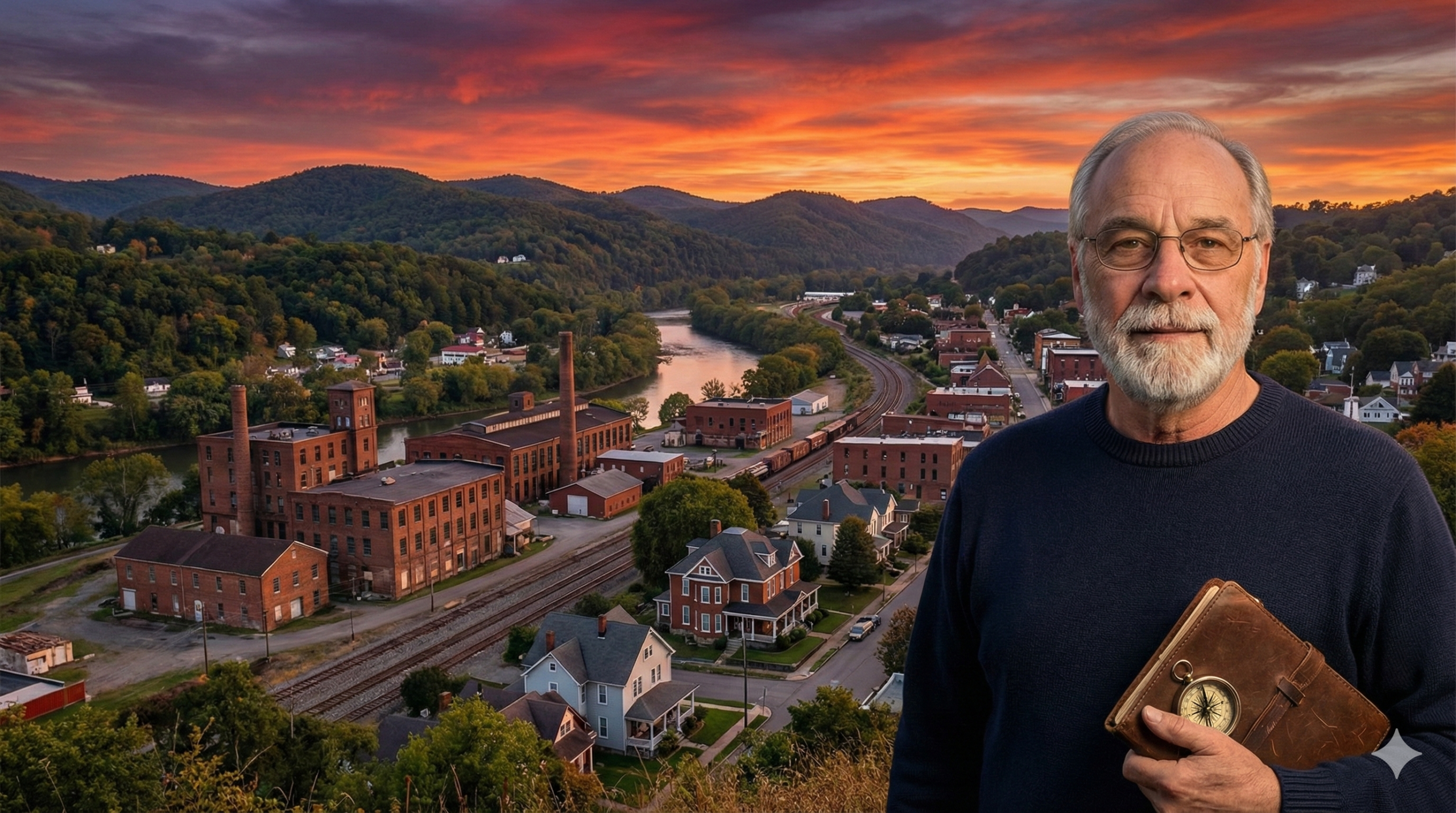
Two Boom Towns, A Century Apart
Consider the Underground Railroad. Not the literal network of safe houses, but the pattern: people fleeing systems that had become unlivable, guided by those who knew hidden routes to places where a different life was possible. Mark Twain’s Hank Morgan traveled backward through time from industrial Connecticut to feudal Camelot, armed with telegraph wire and gunpowder, trying to modernize a civilization that wasn’t ready. I’ve done the inverse—moved forward through geography but backward through industrial time, from the frantic hum of Route 128’s “Silicon Belt” to the Appalachian quiet of Clarksburg, West Virginia, birthplace of Stonewall Jackson.
Both journeys are about escaping one kind of totalitarianism and discovering another form of freedom.
The Massachusetts Machine: 1980s–2010s
In the 1980s and 90s, Route 128 around Boston was the tech corridor before Silicon Valley ate the world. I spent decades inside the machine—literally. DEC (Digital Equipment Corporation), Apollo Computer, Data General, Alliant Computer Systems, Centra Software, Dash.Com—these were the names that built the internet’s foundation, the minicomputer revolution, the client-server architecture that made everything since possible. We wrote in assembly and C, debugged with oscilloscopes, and shipped hardware that weighed more than a person. The “cloud” was a literal raised floor with HVAC units the size of refrigerators.
It was glorious. It was manic. It was fast—Moore’s Law fast, IPO-every-quarter fast, “move fast and break things” before Zuckerberg made it a slogan. But somewhere between Web 2.0 and the smartphone becoming a tracking ankle bracelet, the revolution curdled. The tools we built to liberate information became tools to monetize attention. The open internet became a walled garden. Surveillance capitalism—Shoshana Zuboff’s term for the business model that treats human experience as free raw material for behavioral data—became the only business model that mattered.
By the 2010s, I wasn’t building liberation technology anymore. I was building the prison. Time to get out.
The Kingdom of Appalachia: Clarksburg, West Virginia
Clarksburg had its own boom: coal, natural gas, glassmaking (including world-famous marbles), and railroads made this a transportation and manufacturing powerhouse from the 1880s through the mid-1900s. The architecture tells the story—ornate Victorian homes, a downtown with facades built when this was a destination, not a pass-through. Stonewall Jackson was born here in 1824, back when the region was still Virginia and the future Confederacy was just plantation aristocracy tightening its grip.
Jackson’s story is complicated, like all of Appalachia: a man of rigid discipline and strange contradictions, fighting for a cause that many mountain people opposed (West Virginia split from Virginia specifically to stay with the Union). The hills here have always resisted easy narratives. That’s part of why I’m here.
What Hank Morgan Got Wrong—And What I’m Learning
Twain’s Hank Morgan tried to ram 19th-century industrial democracy down the throat of 6th-century feudalism using guns, factories, and newspapers. It ended in a massacre—thousands of knights electrocuted and machine-gunned in a grotesque preview of World War I. Twain was warning us: technology without wisdom, progress without humility, “disruption” without consent—these are recipes for carnage, not liberation.
I came to Clarksburg not to “fix” it or “modernize” it, but to learn from it. Here’s what I’ve found:
1. Sovereignty Through Simplicity
In Massachusetts, I was connected—to email, Slack, GitHub, surveillance cameras on every corner, license-plate readers, Amazon tracking my purchases, Google tracking my searches. I had computational power and zero privacy. Here, I have hills, a garden, neighbors who know my name, and space the algorithm can’t parse. Surveillance capitalists can’t monetize what they can’t measure. The old Appalachian strategy—being “off the grid” before that was even a concept—is now a cutting-edge privacy technique.
2. Pride Without Nationalism, Heritage Without Hate
The people here are proud of Clarksburg’s history—the glassworks, the rails, the fact that this town mattered—the same way I’m proud of my Portuguese heritage, of ancestors who fished the North Atlantic and built communities in New Bedford, Fall River, Somerset. Pride in place and craft is different from nationalist mythmaking. Twain savaged the fake chivalry of the Old South and medieval Europe alike; real heritage is in the work, not the statues.
3. The Prophetic Left Meets the Dissident Right in These Hills
West Virginia has a radical labor history (the Mine Wars, the Battle of Blair Mountain) and a fierce distrust of coastal elites telling them how to live. That’s not a contradiction—it’s a coalition waiting to happen. Both the justice-focused left and the liberty-focused right should be allies against the real enemy: centralized digital control, corporate extraction (whether of coal or data), and systems that treat people as resources to be mined.
The Trauma of the Digital Age—And the Healing of Distance
You, reader, are digitally wounded. We all are. Every notification is a Pavlovian jolt. Every Terms of Service is a digital feudal contract you sign because refusal means exile. Every “free” app is a Trojan horse. Twain’s peasants couldn’t see their own oppression because the church and aristocracy had colonized their perception. Same with us: we’ve been conditioned to think convenience = freedom, when it’s actually convenience = surveillance.
Healing requires distance. Not everyone can move to the mountains, but everyone can create pockets of sovereignty:
- Local-first tools (apps that run on your device, not someone’s cloud)
- Mesh networks (peer-to-peer communication that doesn’t route through corporate infrastructure)
- Analog backups (paper maps, offline knowledge, skills that don’t require Wi-Fi)
This is what I’m building in Clarksburg—not to escape the future, but to build a different future, one that respects human agency.
The Action: Build Your Own Clarksburg
You don’t need to move to Appalachia. You need to think like Appalachia: decentralized, resilient, skeptical of outsiders promising easy solutions, proud of what you build with your own hands.
Your mission this week:
- Uninstall one surveillance app from your phone. Replace it with a privacy-respecting alternative (DuckDuckGo instead of Google Maps, Signal instead of WhatsApp, etc.).
- Learn one offline skill—grow something, fix something, make something that doesn’t require a server in Virginia or California to function.
- Find your coalition: Talk to someone whose politics you think you disagree with, and find the shared ground around local control and freedom from centralized power. The enemy isn’t left or right—it’s up (the surveillance capitalists and digital totalitarians).
Hank Morgan failed because he thought technology alone could save people. I’m learning that place, limits, and community are the technologies that matter most. Clarksburg taught me that. These hills remember what Silicon Valley forgot: sovereignty isn’t about the fastest processor—it’s about knowing when to unplug.
Welcome to the Brigade. Let’s build liberation, one analog step at a time.
