
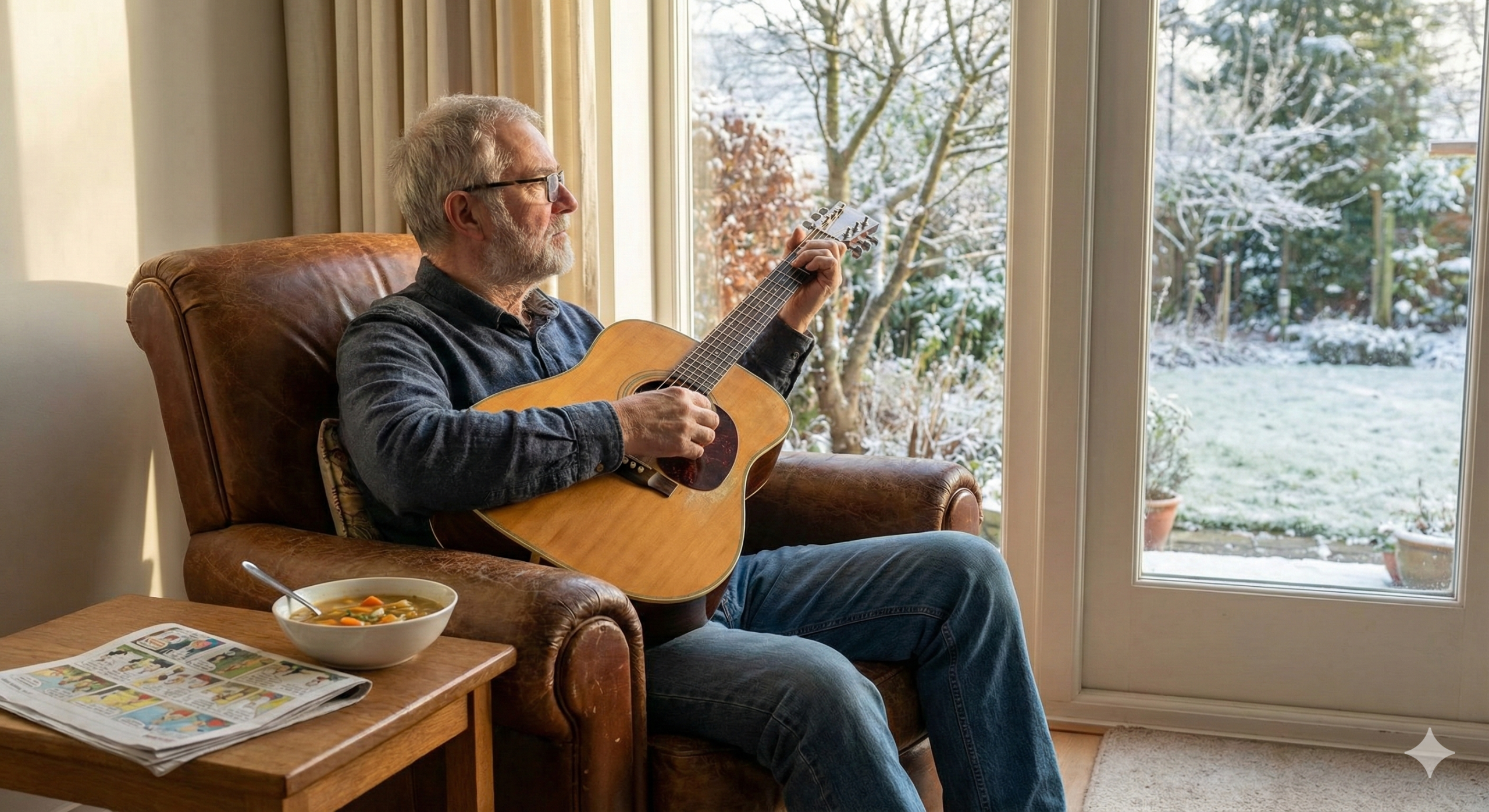
I was sitting by the window this morning, watching the frost cling to the bare branches of the oak tree outside. I had my acoustic guitar in my lap, just strumming a few quiet chords—a little G major to E minor progression—trying to find a melody that matched the stillness of this January morning. Playing music has become one of my most cherished ways to relax; it bypasses the analytical part of my brain and lets me just feel. It is a freedom I never allowed myself before recovery.
In that quiet moment, I learned the news that Scott Adams had passed away. It hit me in a specific, nostalgic way. As a retired software engineer, I spent decades living inside the very world Scott satirized. Those “Dilbertian” cubicles were my reality. I remember clipping his comics out of the paper and taping them to my monitor, a small act of rebellion in a sea of gray carpet. Scott had a genius for exposing the absurdity of the corporate machine, where the “most valuable assets”—us employees—were often treated with minimal appreciation by folks who only cared about the bottom line.
Reflecting on the death of someone I “knew” through their art is a practice I hold dear. I always try to ask: What did I learn from them? What gem can I add to my quiver and carry forward as a torch of hope?
Now, I know Scott became a controversial figure in his later years. There were political and social values he expressed that I simply didn’t agree with. In the past, before I found the rooms of ACA, my dysfunction would have forced me into black-and-white thinking. I would have felt the need to either idolize him completely or villainize him entirely. But emotional sobriety has given me the gift of nuance. I can disagree with the man’s politics while deeply appreciating the smile he put on my face and the glow of humor that warmed my soul during some stressful years in the tech industry.
What struck me most, however, was his final sentiment. He expressed two things that I relate to daily in my recovery journey: the blessing of having an “amazing life” and the drive to “be useful.”
That concept—being useful—resonates deeply with my spirit. In our recovery work, we talk about moving from being “reactors” to “actors.” We talk about being of service to others. To be useful is not about being used or exploited, as I often felt in my dysfunction. It is about contributing to the world with agency and love.
After letting those thoughts settle, I went to the kitchen to prepare lunch. I chopped carrots, celery, and onions for a hearty vegetable soup. Committing to home-cooked meals is another pillar of my self-care routine. As the knife hit the cutting board, I thought about how “being useful” applies to how I treat myself, too. nourishing my body with good food is a way of being useful to the vessel that carries me through this amazing life.
So, thank you, Scott, for the laughs in the cubicle. And thank you for the reminder that it is okay to be controversial instead of a mere sheep. I am taking that gem with me. I am choosing to see the “amazing” in this life, even on a cold winter day.
My hope for us all today is that we can find a way to be useful—to ourselves, to a fellow traveler, or to the world—and to pause long enough to realize that, despite the scars and the past, life truly is amazing.
