
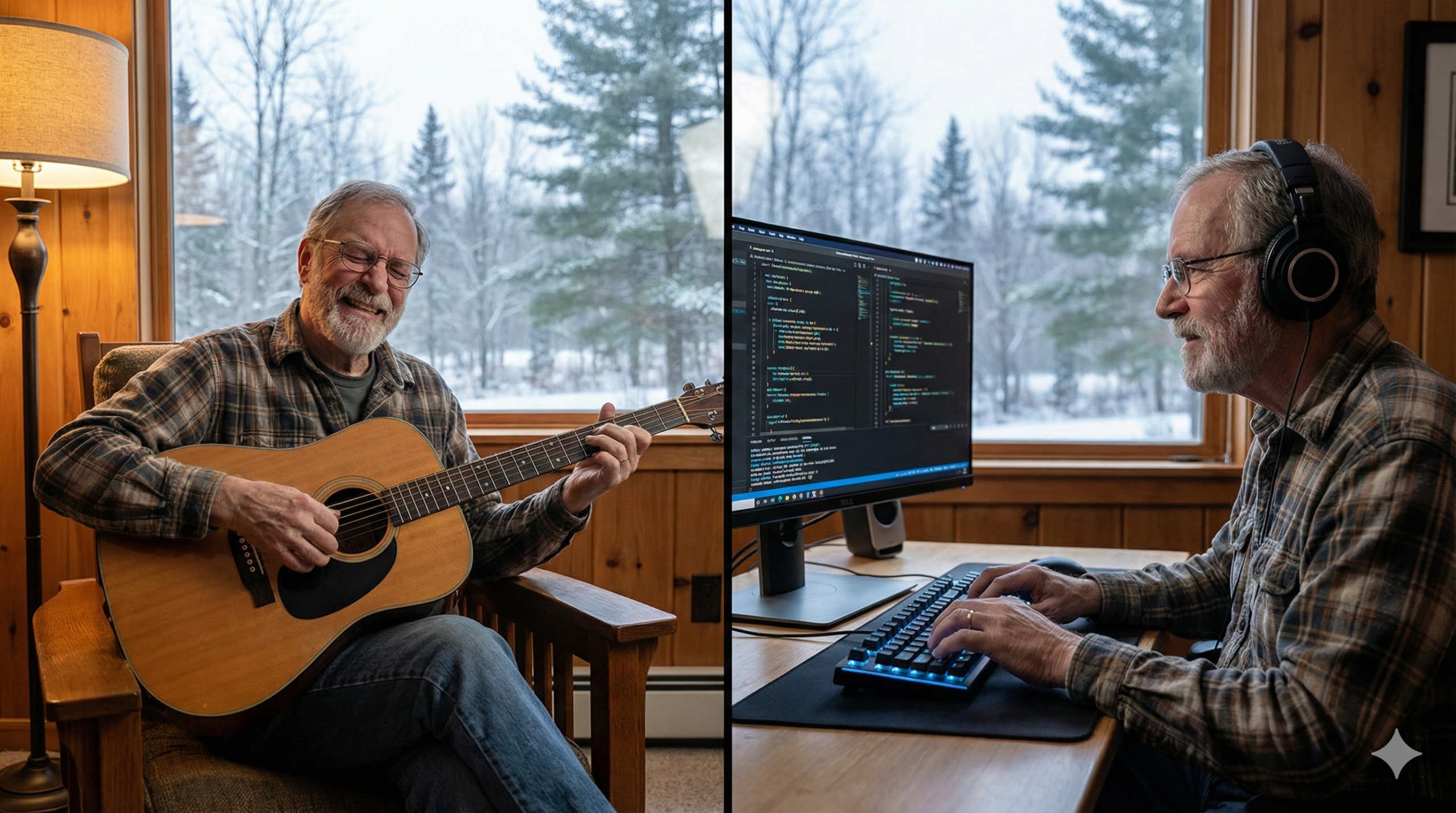
The frost is thick on the windows this morning here in the hills. The garden is fast asleep under a layer of hard earth, and the only green I see is the pine stand at the edge of the property. It’s the kind of January cold that makes you want to stay inside, keep the mini-splits humming, and warm your hands around a mug of hot coffee.
To get my fingers moving, I picked up my old acoustic guitar today. I’ve been playing almost a decade now, but I still remember the frustration of the early days. I remember staring at my left hand, willing my stiff fingers to form a C-chord, feeling like I was fighting the wood and wire. It was a mechanical struggle. But today? Today, I didn’t look at my hands once. I heard a melody in my head—a little folk tune that felt like winter—and my hands just knew where to go. The instrument disappeared. There was no wood, no steel, no fretboard. There was only the sound.
This transition, from struggle to flow, is what I call the “Liberation of Competence.” And as a retired engineer who spent thirty-five years navigating the evolution of technology—from fixing massive mainframes in the Army to managing cloud architecture as a VP—I can tell you that this feeling isn’t unique to music. It is the holy grail of software engineering.
When I think about “Liberation Technology,” we often think about the big picture: privacy, decentralized networks, and freedom from algorithmic control. And those things are vital. But there is a personal liberation that comes before all of that. It’s the freedom found in mastery.
I remember my early days of coding. I was constantly checking manuals —god, remember manuals!— worrying about semicolons, and fighting with the compiler. I was wrestling with the syntax, just like I wrestled with that guitar neck. But after years of typing, something magical happened. The syntax became muscle memory. I stopped thinking about how to write a Class or loop a function. I started thinking about the concept, and the code just appeared on the screen.
When you reach that point, you aren’t fighting the computer anymore; you are dancing with it. That is where the joy lives. That is where the geeky thrill of pushing a machine to its maximum productivity becomes an art form.
There is a profound spiritual freedom in this, especially now. We live in a noisy world. If you turn on the news or scroll through the social feeds in 2026, it feels like a firehose of chaos. Opinions, arguments, and unpredictability are everywhere. But when I open a blank file in VS Code, I feel a deep sense of peace.
The empty editor isn’t a void; it’s infinite potential. It is a sanctuary of order. In that text box, the laws of physics are replaced by the laws of logic, and those laws obey me perfectly. If I write the logic correctly, the program works. If I make a mistake, it breaks, but it breaks for a reason I can find and fix. There is no ambiguity. There is no spin.
I can create a universe in that editor where everything makes sense. I can play a minor key on the piano to feel that sweet sorrow, or I can write a script to automate a tedious task and feel the triumph of efficiency. And the best part? I know where the power switch is. I can turn it all off, walk away, and go chop vegetables for a stew or forest bath with eagles along a ridge that parallels a river.
My hope for you, fellow traveler, is that you find your own version of this sanctuary. Maybe it’s in a workshop, a garden, or a line of code. Don’t be discouraged by the clumsy phase where you have to stare at your fingers. Keep going. Push through the friction until the tool disappears. Because when the tool disappears, you are free. You are no longer just a user or a consumer; you are a creator. And in a world that tries to automate everything, remaining a creator is the ultimate act of liberation.
