
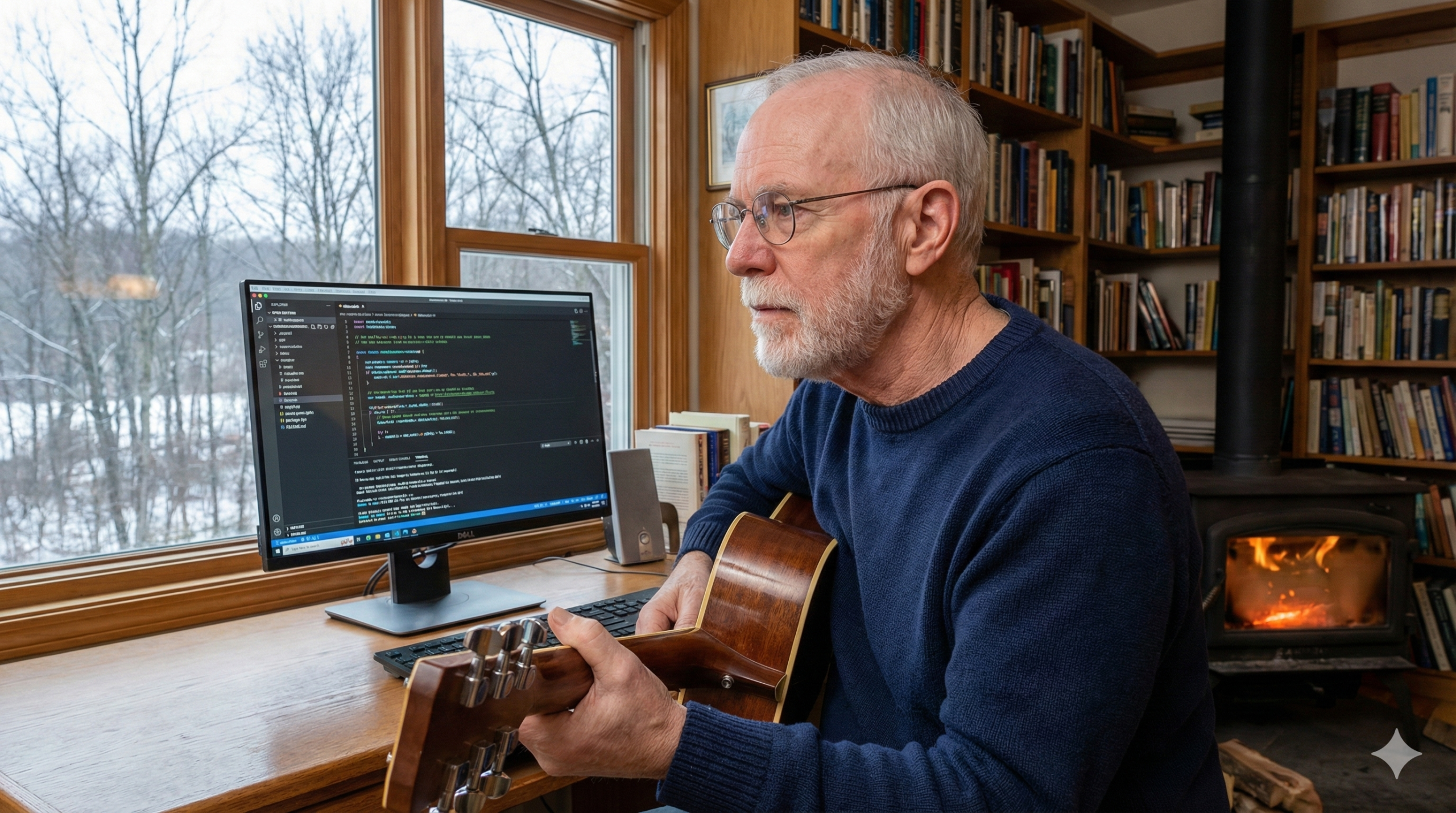
It is a crisp, gray Saturday here in the Appalachian mountains. The hills outside my window are stripped bare, the trees standing like skeletal antennas waiting for a signal. I’ve been sitting by the woodstove, trying to nail the transition from G to B-minor on my acoustic guitar. It’s a tricky shift—your fingers have to reorganize in space instantly, or the rhythm stumbles and the song falls apart.
Later, sitting at my desk working on a new Flutter widget, I realized I was doing the exact same thing. I was reorganizing data structures in memory so the processor wouldn’t stumble. Whether it’s the fretboard or the keyboard, the goal is the same: to organize chaos into a harmony that serves a purpose. That moment when the code runs clean? These are a few of my favorite things!
In my 35 years in this industry—from fixing computers in the Army to sitting in the corner office as a CTO—I have seen technology shift from a tool we controlled to a system that often tries to control us. But here in 2026, I am finding so much joy in a new role: the Liberation Technologist.
Now, don’t let the fancy title scare you. At its heart, a liberation technologist is just a builder who prioritizes human freedom and community over profit. It’s about being a fellow traveler on this digital journey, sharing what we know so we can all walk a little lighter.
For a long time, we were stuck in what researchers call a “digital double bind”. We needed the internet for our jobs and our social lives, but using it meant exposing ourselves to surveillance and algorithms that wanted to keep us angry and scrolling. It felt like playing a guitar that was constantly out of tune.
But the beautiful thing about being an engineer is that when something is broken, we fix it. We are seeing a “protocol revolution” right now. Instead of being locked into one big platform that owns our data, we are moving toward “usable decentralization”… I hope!
Think of it like my garden out back. Right now, it’s dormant under the frost, but I’m already planning my spring rows. I don’t buy my vegetables from a factory that tells me what to eat; I grow them. In the same way, platforms like Bluesky are growing because they allow us to choose our own algorithms. We can decide to see a “Human Rights Feed” or a “Tech Hobbyist Feed” rather than whatever generates the most outrage. We are moving from being passive users to active architects of our own experience.
I get excited about this because it reminds me of the early days of computing. There is a spirit of “sovereign hardware” coming back, like the Precursor device, which lets you verify exactly how your computer is thinking. It’s the digital equivalent of cooking a home-cooked meal—you know exactly what ingredients went into it, so you know it’s good for you. GIGO! Garbage In, Garbage Out!
This isn’t just about privacy; it’s about health. In my own recovery and journey toward better health, I’ve learned that you have to protect your peace. You can’t drink from a firehose of noise and expect to sleep well at night. By using these new tools—whether it’s encrypted mesh networks that work off the grid or just smarter ways to filter our news—we are building a “digital sanctuary”.
We build these systems not because we hate technology, but because we love it. We want it to work for us. We want to be able to close the laptop, pick up the guitar or sit at the piano, and know that our digital lives are secure, leaving us free to focus on the next chord change.
So, if you’re feeling overwhelmed by the screen today, take a breath. You have choices. We are building a future that is resilient, like the mycelium networks under the forest floor. We are tuning the instrument. And let me tell you, the music is starting to sound pretty good.
