
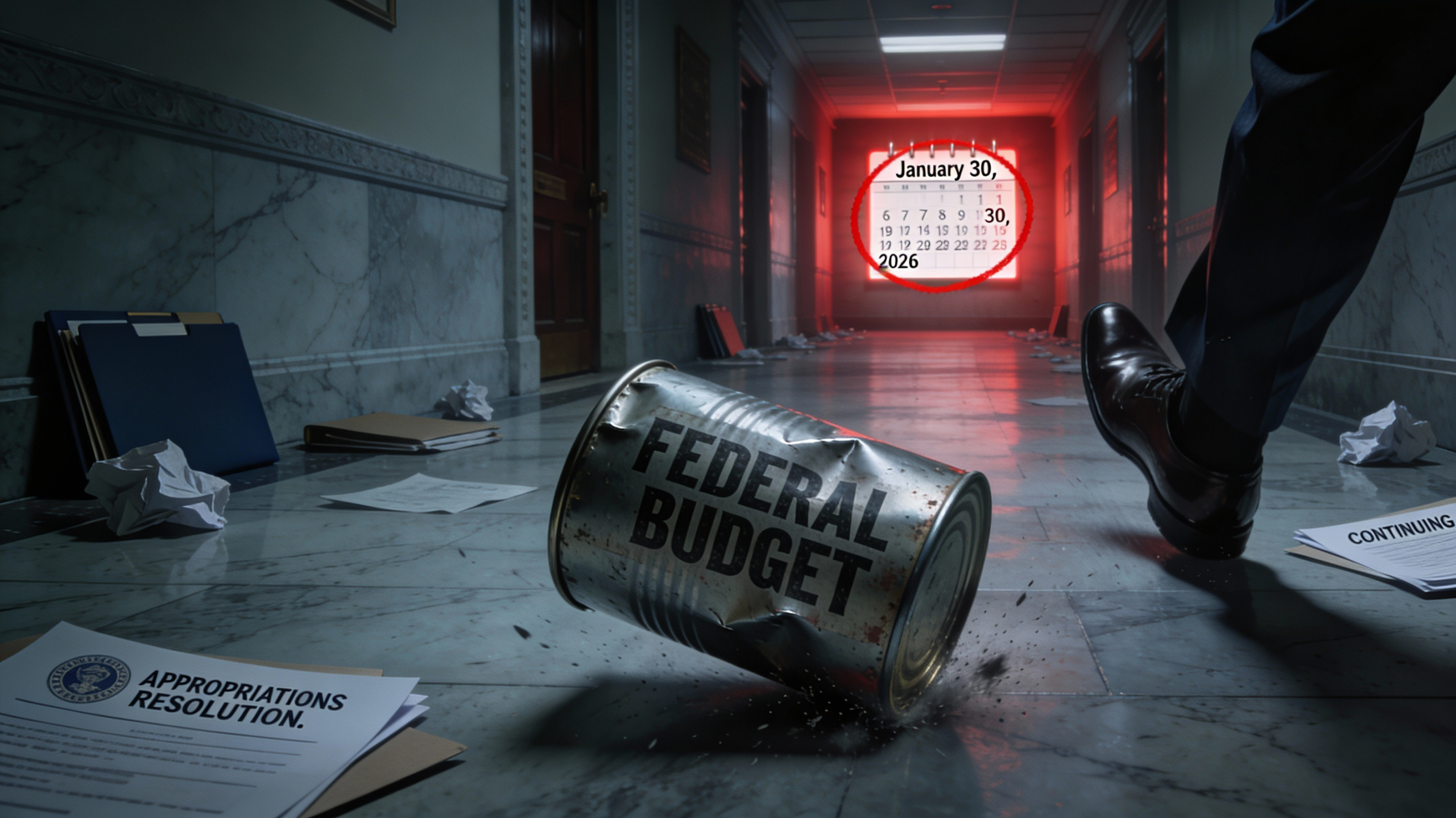
Congress has perfected an art form: the illusion of solving problems without actually solving them.
On November 12, 2025, President Trump signed legislation that officially ended the longest government shutdown in American history—a devastating 43-day closure that left over one million federal workers unpaid and cut food assistance to millions of Americans. But here’s the trick that nobody wants to talk about: the shutdown didn’t really end. It was simply postponed.[1][2]
The continuing resolution that “reopened” the government didn’t actually fund it. It merely kicked the can down the road to January 30, 2026—just 25 days away. In this series on the debt crisis, I’ve explained how the $38 trillion national debt is mathematically unsustainable and how the government is forced into financial repression to keep the system alive. But the shutdown crisis reveals something even more dangerous: Congress has lost the basic ability to govern.
And January 30th will prove it.
The Can Has Been Kicked So Many Times, It Has a Dent
This isn’t a new problem. This is a pattern of cascading failure.
Since fiscal year 1998, Congress has enacted 139 continuing resolutions. That means, in the last 28 years, Congress has completely failed to pass a proper budget even once. Instead, they’ve scrambled together temporary band-aids every few months.[3]
Before 2025, the longest shutdown was 35 days during Trump’s first term over border wall funding. The 2025 shutdown lasted 43 days. The escalation is not accidental. Each shutdown gets longer, each creates more damage, and each reveals deeper dysfunction.[1]
But here’s what makes January 30 different: Congress cannot afford to fail again.
Only 3 of 12 Bills Funded; 9 Remain in Limbo
When Trump signed the November 12 bill, it provided full-year funding for only three appropriations bills out of 12:[3]
- Agriculture and FDA
- Legislative Branch (Congress itself)
- Military Construction and Veterans Affairs
The other nine—which fund the Department of Defense, NASA, NOAA, the FAA, the courts, Homeland Security, Transportation, and virtually every other critical agency—are funded only through January 30, 2026 at FY 2025 levels.[1][3]
This is the deadlock: Congress has less than 50 days to pass nine major appropriations bills. That has never happened in recent history.[1]
The Stalemate: Why They Cannot Agree
The impasse is not about obscure budget line items. It’s about three irreconcilable issues:
1. The ACA (Affordable Care Act) Subsidy Cliff
Democrats demanded a three-year extension of ACA premium tax credits that are set to expire. Without it, millions of Americans would see their health insurance costs skyrocket. Republicans refused to include it in the November deal. The vote on ACA subsidies failed in December—both Democratic and Republican proposals collapsed. This poison pill sits at the center of every negotiation.[4][2][5]
2. The Colorado Funding Dispute
Democratic Senators Michael Bennet and John Hickenlooper blocked the entire spending package in December over the Trump administration’s decision to dismantle the National Center for Atmospheric Research in their home state. This “local” issue held up the entire federal budget. When you can’t resolve one university research center, how do you resolve nine major appropriations bills?[6]
3. The Defense Dilemma
The Defense Department is the single largest appropriation. But Republicans want higher defense spending while Democrats want more social spending. With the political economy in chaos and both parties weakened by the previous shutdown, neither side can force a win.[6]
The Fiscal Dominance Signal: The Market Is Watching
Here’s what investors are watching that the news misses: Congress cannot even pass routine appropriations in a debt crisis.
Remember from my first post in this series: the U.S. government is now in “fiscal dominance,” meaning the Federal Reserve has lost control to the Treasury’s demands. The Fed must print money to keep interest rates low enough that the government can service its debt.
But here’s the catch: the Federal Reserve’s entire legitimacy rests on the assumption that American institutions can make hard choices. If Congress is so dysfunctional that it cannot pass a budget without a 43-day crisis and another one looming on January 30, the international bond market will conclude: These people cannot manage $38 trillion in debt.
The soft default requires belief. It requires Chinese central banks and Japanese pension funds and Middle Eastern sovereign wealth funds to believe that the U.S. will muddle through. But a government that cannot pass basic appropriations bills signals desperation.
The Economic Consequences: The Can Bounces
When the November shutdown ended, the damage didn’t magically disappear. Federal workers received back pay, but they lived through weeks of financial terror. Immigration courts remained backlogged—processing delays that persist for months. Visa applications froze. PERM labor certifications halted.[2][4]
This creates a hidden drag on the economy called “institutional uncertainty.” When businesses cannot plan because they don’t know if the government will function in 25 days, they don’t hire. When federal workers don’t know if they’ll be paid, they don’t spend. When investors see government paralysis, they sell.
The stock market will not crash on January 30th if another shutdown happens. It will crash because another shutdown will be the final signal that the U.S. government lacks the institutional capacity to manage its own affairs.
Why This Time Is Different: The RIFs and the Threat of Permanent Layoffs
There’s a dagger hidden in the continuing resolution. The November bill included a provision that paused all Reductions-in-Force (RIFs) through January 30.[7][8]
But after January 30? The gloves come off.
If Congress doesn’t pass a full appropriations bill by that date, agencies are set to begin massive layoffs of federal workers. Thousands of workers who were rescinded from RIFs will be terminated permanently. This isn’t just about paychecks; this is about whether the federal government can execute policy.[7]
You cannot fight a trade war with China if you’ve laid off the Commerce Department. You cannot manage immigration if you’ve eliminated the Department of Homeland Security’s workforce. You cannot maintain nuclear weapons without the Department of Energy.
Yet this is the implicit threat hanging over January 30: either Congress passes a budget, or the federal government starts staffing like a failing business in Chapter 11.
The Contradiction at the Heart of the Debt Crisis
Here’s the trap that nobody wants to discuss: You cannot solve a $38 trillion debt crisis without a functional government. And you cannot maintain a functional government while the debt crisis is destroying fiscal capacity.
The government is trying to thread a needle between:
- Keeping interest rates low enough (via Fed printing) that the debt is sustainable
- Maintaining institutional credibility enough that international investors keep buying Treasuries
- Preventing complete loss of confidence that would trigger capital flight
But Congress shutdown theater destroys credibility. Each shutdown signals weakness. Each continuing resolution signals dysfunction. Each missed deadline tells the world: “These people don’t even know how to manage their own budget, let alone $38 trillion in debt.”
The January 30 Reckoning
Two scenarios play out after January 30:
Scenario A: Another Shutdown (60% probability)
Congress deadlocks again. The government partially shuts down for weeks or months. Federal workers, already traumatized by the 43-day shutdown, face another crisis. The stock market sells off hard. Foreign investors, seeing American institutional collapse, begin to move capital out of dollars and U.S. assets.
Scenario B: A Capitulation Deal (40% probability)
One side caves at the last minute. Republicans capitulate on ACA subsidies, or Democrats accept defense spending cuts. The government stays open, but the deal signals that Congress has given up on fiscal responsibility. The debt continues to spiral. Interest rates stay artificially suppressed. Inflation continues. The soft default accelerates.
Either way, January 30 is not a solution. It’s a mirror held up to the inability of a $38 trillion debtor to manage even basic governance.
The Message to the Bond Market
International investors are listening to the sound of the can being kicked.
Each time Congress narrowly averts a shutdown, it sends a message: “We are so paralyzed that we can barely keep the lights on.” That message, repeated every 60 days, erodes the confidence that foreign central banks need to keep buying Treasuries.
You cannot maintain the fiction of a “risk-free” U.S. Treasury bond when the U.S. government cannot reliably fund itself past the next month. The cascade has begun. It started with the 43-day shutdown. It continues with the January 30 deadline.
And it won’t end until Congress either makes hard fiscal choices or admits that the system is broken.
The fiscal dominance era doesn’t end with a bang. It ends with the sound of a can being kicked down an empty hallway, toward a wall that gets closer with every kick.
Sources
[1] Longest Government Shutdown in History Ends After 43 days https://spacepolicyonline.com/news/longest-government-shutdown-in-history-ends-after-43-days/
[2] Could 2026 bring another government shutdown, after the longest … https://wtop.com/local/2025/12/could-2026-bring-another-government-shutdown-after-the-longest-shutdown-ever/
[3] What Is a Continuing Resolution? – Peterson Foundation https://www.pgpf.org/article/what-is-a-continuing-resolution/
[4] U.S. Government Faces Another Partial Shutdown After January 30 … https://fakhouryglobal.com/immigration-alerts/u-s-government-faces-another-partial-shutdown-after-january-30-2026/
[5] Government shutdown ends without extension of ACA tax credits https://www.cmadocs.org/newsroom/news/view/ArticleId/51058/Government-shutdown-ends-without-extension-of-ACA-tax-credits
[6] A month out, no one looking to repeat October’s historic shutdown https://www.politico.com/news/2026/01/03/trump-shutdown-january-00700940
[7] The 5 biggest stories federal agencies and employees need to … https://www.govexec.com/management/2025/12/5-biggest-stories-federal-agencies-and-employees-need-watch-2026/410319/
[8] Congress Ends Shutdown: What the New Funding Law Means for … https://www.huschblackwell.com/newsandinsights/congress-ends-shutdown-what-the-new-funding-law-means-for-major-industries
[9] Longest Government Shutdown in U.S. History Ends After 43 Days https://www.nado.org/longest-government-shutdown-ends/
[10] Federal Funding Outlook Following the End of the Government … https://www.policechiefmagazine.org/fed-fund-outlook-following-the-end-of-gov-shutdown/
[11] Epstein, health care and a shutdown fight: Here’s what the House … https://thehill.com/homenews/house/5662836-epstein-health-care-shutdown-house/
[12] 2026 Government Funding Update ℹ️ MFAN remains committed to … https://www.facebook.com/MilitaryFANet/posts/%EF%B8%8F-2026-government-funding-update-%E2%84%B9%EF%B8%8F-mfan-remains-committed-to-keeping-military-f/1274054141419455/
[13] Federal Government Reopens Following Longest Shutdown in History https://news.aai.org/2025/11/19/federal-government-reopens-following-longest-shutdown-in-history/
[14] Guidance on Government Shutdowns | Office of the Provost https://provost.uark.edu/shutdown/
[15] Longest federal government shutdown on record may end soon https://afterschoolalliance.org/afterschoolSnack/Longest-federal-government-shutdown-on-record-may-end-soon_11-10-2025.cfm
[16] Congress Passes Legislation Ending the Longest Government … https://amchp.org/2025/11/13/congress-passes-legislation-ending-the-longest-government-shutdown-in-u-s-history/
[17] Upcoming Congressional Fiscal Policy Deadlines-2025-11-20 https://www.crfb.org/blogs/upcoming-congressional-fiscal-policy-deadlines
[18] The government shutdown is now the longest ever—and the public … https://ourpublicservice.org/blog/the-government-shutdown-is-now-the-longest-ever-the-public-is-paying-the-price/
[19] Federal Government Shutdown: What It Means for States and … https://www.ncsl.org/in-dc/federal-government-shutdown-what-it-means-for-states-and-programs
[20] The Longest Government Shutdown in US History Has Ended … https://www.npca.org/articles/11212-the-longest-government-shutdown-in-us-history-has-ended-what-s-next-for
